The cheapest material is rarely the most economical one — and in specialty lubrication chemicals, that gap between cheap and economical can prove remarkably costly.
A solid lubricant, anti-friction spray, high-temperature grease or specialty additive may look like a minor line item in a procurement budget. Yet when its quality wavers, the consequences surface somewhere far more expensive: increased friction, accelerated wear, shortened component life, heavier maintenance and unplanned downtime.
For manufacturers operating high-temperature, heavy-load or precision equipment, lubrication is not simply about reducing friction. The right lubrication solution can influence equipment reliability, component life, maintenance requirements and production efficiency.
This is why sourcing specialty lubrication chemicals requires more than comparing prices between suppliers.
So, what should Indian manufacturers truly look for when selecting a specialty lubricant supplier?
1. Begin With the Application, Not the Price
The right lubricant is defined by where and how it will be used.
Operating temperature, load, speed, pressure, surface condition, chemical exposure and processing environment can all influence the choice of an industrial lubrication solution. A lubricant that performs well in a conventional application may not necessarily be suitable for extreme temperatures, heavy loads or specialised manufacturing processes.
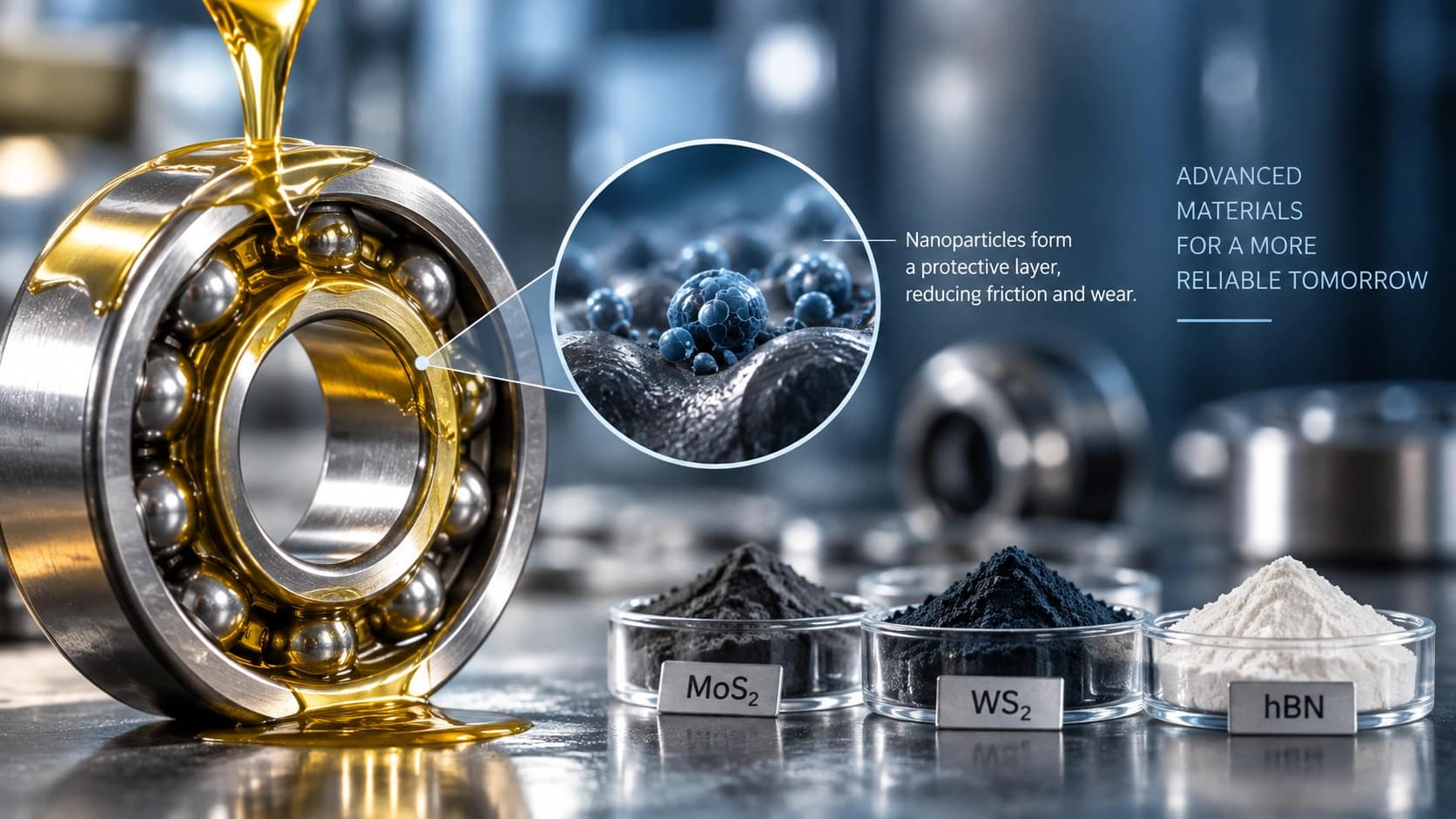
This is particularly important when evaluating specialty industrial lubricants and solid lubricants. Materials such as Tungsten Disulfide (WS₂), Molybdenum Disulfide (MoS₂), Hexagonal Boron Nitride (hBN) and PTFE-based materials have different characteristics and applications.
For example, Tungsten Disulfide (WS₂) powder is used in specialised lubrication applications where low friction and performance under demanding conditions are important. MoS₂ is widely recognised as a solid lubricant, while hBN is valued for its lubricating and thermal properties. PTFE-based materials are also used across a range of industrial formulations.
The first question should therefore not be:
“What is the price per kilogram?”
It should be:
“What lubrication problem are we trying to solve?”
A knowledgeable industrial lubricant supplier should understand the application before recommending a product. The objective is not necessarily to select the most expensive material, but to identify the right specialty lubrication chemical for the operating environment.
2. The Product Name Is Only the Beginning of the Specification
“MoS₂ powder.” “hBN powder.” “PTFE powder.”
These are starting points, not complete specifications.
The product name alone does not tell an engineering or procurement team everything it needs to know about performance. Grade, purity, particle size, particle-size distribution, formulation compatibility and application method can all influence how a specialty lubricant performs.
For example, manufacturers sourcing Molybdenum Disulfide (MoS₂) powder may need to evaluate the grade and particle characteristics required for their specific application. The same principle applies when selecting Hexagonal Boron Nitride (hBN) powder or PTFE Micronized Powder.
Two products carrying the same commercial name may not necessarily deliver identical results in a live manufacturing process.
Manufacturers should therefore ask suppliers questions such as:
- What grade is being supplied?
- What is the purity level?
- What is the particle size?
- Is the material consistent between batches?
- Is it compatible with the intended formulation?
- What operating conditions is it designed for?
- What application method is recommended?
- What technical documentation is available?
A reliable lubrication chemicals supplier should be able to explain which specifications actually matter for the customer’s application rather than simply providing a product name and price.
This makes supplier comparisons more meaningful and helps manufacturers avoid selecting a product based solely on cost.
3. Consistency Is Non-Negotiable
Picture a lubricant that performs flawlessly in January and behaves unpredictably by March.
Your production line takes no comfort in how excellent that first batch was.
For manufacturers, batch-to-batch consistency can be just as important as the product specification itself. Changes in material characteristics can create challenges for production, quality control and engineering teams.
This becomes particularly relevant when specialty lubrication chemicals are incorporated into a manufacturing process or formulation.
A change in particle characteristics, purity or other technical properties can potentially affect friction, wear, coating behaviour or overall process performance.
The essential question when evaluating a supplier is simple:
Can they deliver the same quality, reliably, again and again?
For OEMs and plants running continuous operations, consistency can directly influence the reliability of the manufacturing process.
Manufacturers should therefore evaluate more than a single sample wherever possible. Clear product specifications and consistent quality across repeat orders provide a stronger foundation for long-term procurement.
A dependable specialty lubricant supplier should understand that an industrial customer is not making a one-time purchase. The material is becoming part of an ongoing production process.
4. Insist on Proper Technical Documentation
A serious lubrication supplier should stand behind its products with appropriate technical documentation.
Depending on the product and application, this may include Technical Data Sheets, Safety Data Sheets, product specifications, certificates of analysis and relevant compliance documentation.
This is not documentation for its own sake.
Technical documentation gives engineering, quality and procurement teams a common reference point for evaluating and approving a material.
It also becomes extremely useful when comparing suppliers. Instead of evaluating products purely on price, procurement teams can compare relevant technical specifications and determine whether the materials are genuinely comparable.
Before placing a long-term order, manufacturers should consider requesting:
- Technical Data Sheets
- Safety Data Sheets
- Product specifications
- Grade and purity information
- Relevant quality documentation
- Packaging and storage information
- Application recommendations
- Compliance documentation where applicable
A transparent supplier makes it easier for customers to evaluate, approve and reorder specialty industrial lubricants with confidence.
5. Seek a Technical Partner, Not Just a Product Supplier
Here lies a meaningful distinction.
A supplier sells you a lubricant.
A technical partner helps you solve a lubrication problem.
In specialty lubrication, the customer’s requirement may not always fit neatly into a standard product description.
What happens when a different grade is required? When particle size needs to change? When a material needs to be incorporated into another formulation? Or when a performance issue appears on the production line?
These are situations where technical understanding becomes valuable.
A strong industrial lubricant supplier should be willing to understand the application, operating conditions and performance expectations before recommending a solution.
This is particularly important when sourcing solid lubricants, industrial greases, anti-friction sprays, specialty powders or high-temperature lubrication solutions.
6. Reliability Is a Dimension of Quality
A technically superb lubricant that fails to arrive when your production line needs it remains, quite simply, a problem.
In manufacturing, availability matters.
A production facility may have validated a particular lubricant and incorporated it into its procurement system. If that material suddenly becomes unavailable or delivery becomes unpredictable, the impact can extend to production schedules, maintenance planning and inventory management.
This is particularly relevant when sourcing products such as High-Temperature EP Grease, solid lubricants, anti-friction sprays, hBN coatings and specialty powders.
Procurement teams should consider whether a supplier can support repeat orders, communicate realistic lead times and maintain supply as requirements change.
The lowest quotation has little value if supply problems eventually create production delays or require the manufacturer to qualify an alternative material at short notice.
Reliability should therefore be considered part of the overall value of a specialty lubrication chemical.
7. Look Beyond the First Order
The true measure of a supplier is not one successful batch.
It is whether they can support you as your production volume grows, your specifications evolve or your applications become more demanding.
A manufacturing relationship may begin with a small technical requirement and eventually develop into a long-term sourcing partnership.
A manufacturer may move from laboratory trials to pilot production and then to larger commercial volumes. An OEM may introduce a new component requiring a different lubrication approach. A plant may need a different grade to address changing operating conditions.
This is why manufacturers should evaluate a supplier’s ability to support the next requirement, not just fulfil today’s purchase order.
Questions worth considering include:
- Can the supplier support increasing volumes?
- Can they maintain product consistency?
- Can they provide different grades when required?
- Can they support new applications?
- Can they provide technical information when specifications change?
- Can they maintain reliable supply over the long term?
That is when a transaction becomes a technical partnership rather than simply another supplier relationship.
8. Consider the Total Cost of Lubrication
One of the biggest mistakes in industrial procurement is looking only at the purchase price of the material.
The actual cost of lubrication can extend far beyond the invoice.
A lower-priced material may initially appear attractive, but if it contributes to higher consumption, more frequent maintenance, shorter component life or increased downtime, its overall cost can become significantly higher.
This is why manufacturers should consider total cost of ownership when evaluating industrial lubrication solutions.
A specialty lubricant with a higher purchase price may provide better overall value if it meets the application’s performance requirements and supports reliable equipment operation.
The objective of procurement should therefore not simply be to minimise the purchase price.
It should be to achieve the lowest practical overall cost while maintaining the required lubrication performance.
9. Match the Lubricant to the Operating Environment
Industrial lubrication becomes more demanding as operating conditions become more extreme.
Conventional oils and greases may not always be suitable for applications involving very high temperatures, extreme pressure, specialised surfaces or demanding component requirements.
This is where specialty industrial lubricants and solid lubricants can become important.
Materials such as WS₂, MoS₂ and hBN have applications where friction, wear and operating conditions need to be carefully considered. PTFE-based materials are also used in various industrial formulations where their specific properties are appropriate.
There is no single “best” specialty lubricant for every application.
The correct material depends on factors such as:
- Temperature
- Load
- Pressure
- Speed
- Friction requirements
- Surface characteristics
- Chemical environment
- Component material
- Application method
- Required service life
Manufacturers should therefore select a lubrication chemical based on the complete operating environment, rather than choosing a material simply because it is widely used.
Application-specific selection is ultimately what turns a generic lubricant purchase into a properly considered industrial lubrication solution.
10. Evaluate the Supplier’s Industry Understanding
Specialty lubrication chemicals are used across a wide range of industrial environments.
The requirements of a foundry can be very different from those of an aluminium extrusion plant. Steel rolling mills, bearing manufacturers, aerospace component manufacturers and thermal power plants may each face different lubrication challenges.
A supplier with experience across demanding industrial applications can provide a more informed starting point for product selection.
High-temperature applications may require consideration of thermal performance. Heavy-load applications may require a different approach to friction and wear. Coating applications may require attention to formulation compatibility and application technique.
This is why industry understanding should be considered alongside product availability.
The question is not simply:
“Does the supplier sell this chemical?”
It is:
“Does the supplier understand where and why this chemical is being used?”
That distinction can make the sourcing process considerably more effective for engineering, maintenance and procurement teams.
A supplier’s value is therefore not only in the products it supplies, but also in the technical understanding it brings to the sourcing relationship.

The Bigger Question: What Makes a Specialty Lubricant Supplier Reliable?
India’s manufacturing sector is advancing toward greater precision, higher quality and increasingly demanding applications.
In this environment, specialty lubricants are no longer simply another procurement item. They can directly influence friction, wear, equipment reliability, productivity and product quality.
For procurement teams, selecting a specialty lubrication chemicals supplier therefore requires looking beyond the immediate price.
A reliable sourcing decision should consider:
Application suitability
Technical specifications
Product consistency
Documentation
Technical support
Supply reliability
Long-term scalability
Total cost of ownership
This is the thinking that shapes how we work at Jade Chemicals.
Based in Bangalore, Jade Chemicals supplies specialty industrial lubricants and lubrication chemicals to manufacturers across India. Our range includes solid lubricants such as Tungsten Disulfide (WS₂), Molybdenum Disulfide (MoS₂) and Hexagonal Boron Nitride (hBN), along with PTFE Micronized Powders, High-Temperature EP Grease, Anti-Friction Sprays and hBN Coatings.
These materials are used for demanding industrial applications across sectors including foundries and forging, aluminium extrusion, steel rolling mills, bearings, aerospace components and thermal power plants, among others.
Whether the requirement is for a solid lubricant, high-temperature lubrication solution, specialty powder, anti-friction coating or industrial grease, the starting point should always be the same:
Understand the application. Define the requirement. Select the right material.
Because in industrial lubrication, the cheapest product is not necessarily the lowest-cost solution.
The better question is:
What delivers the right performance, consistently, reliably and economically over the life of the application?
That is where the real value of a specialty lubrication chemical is found.
To learn more about Jade Chemicals, our specialty industrial lubricants and the industries we serve, visit: www.jadechemicals.in
Frequently asked questions
Hexagonal Boron Nitride is used in high-temperature lubrication, mould release, surface protection, thermal management and electrical insulation. Industrial applications include metal processing, forging, aluminium extrusion, tooling and high-temperature manufacturing. It is also being studied for electronics and two-dimensional material technologies.
Hexagonal Boron Nitride has a layered structure that gives it useful dry-lubrication characteristics. It can be used in applications where conventional oil- or grease-based lubricants may not be suitable because of high temperatures. hBN powder and hBN coatings are therefore used for selected high-temperature industrial applications.
No. Hexagonal Boron Nitride is an electrical insulator. This is one of its important differences from graphite and is a key reason it is being investigated for thermal-management and electronic applications.
Hexagonal Boron Nitride is more accurately described as a wide-bandgap electrical insulator, rather than a conventional semiconductor. Its importance in semiconductor and advanced electronics research comes from its use as a dielectric, insulating layer, substrate and encapsulation material alongside other semiconductor and two-dimensional materials.
Hexagonal Boron Nitride is used across metal processing, aluminium extrusion, forging, aerospace, electronics, thermal management and advanced materials. Its established industrial uses include dry lubrication, release and surface protection in high-temperature applications.
Jade Chemicals supplies Hexagonal Boron Nitride powder in India in different particle sizes and grades for industrial applications. The company also supplies hBN coatings and aerosol formulations for high-temperature lubrication, release and surface-protection applications.