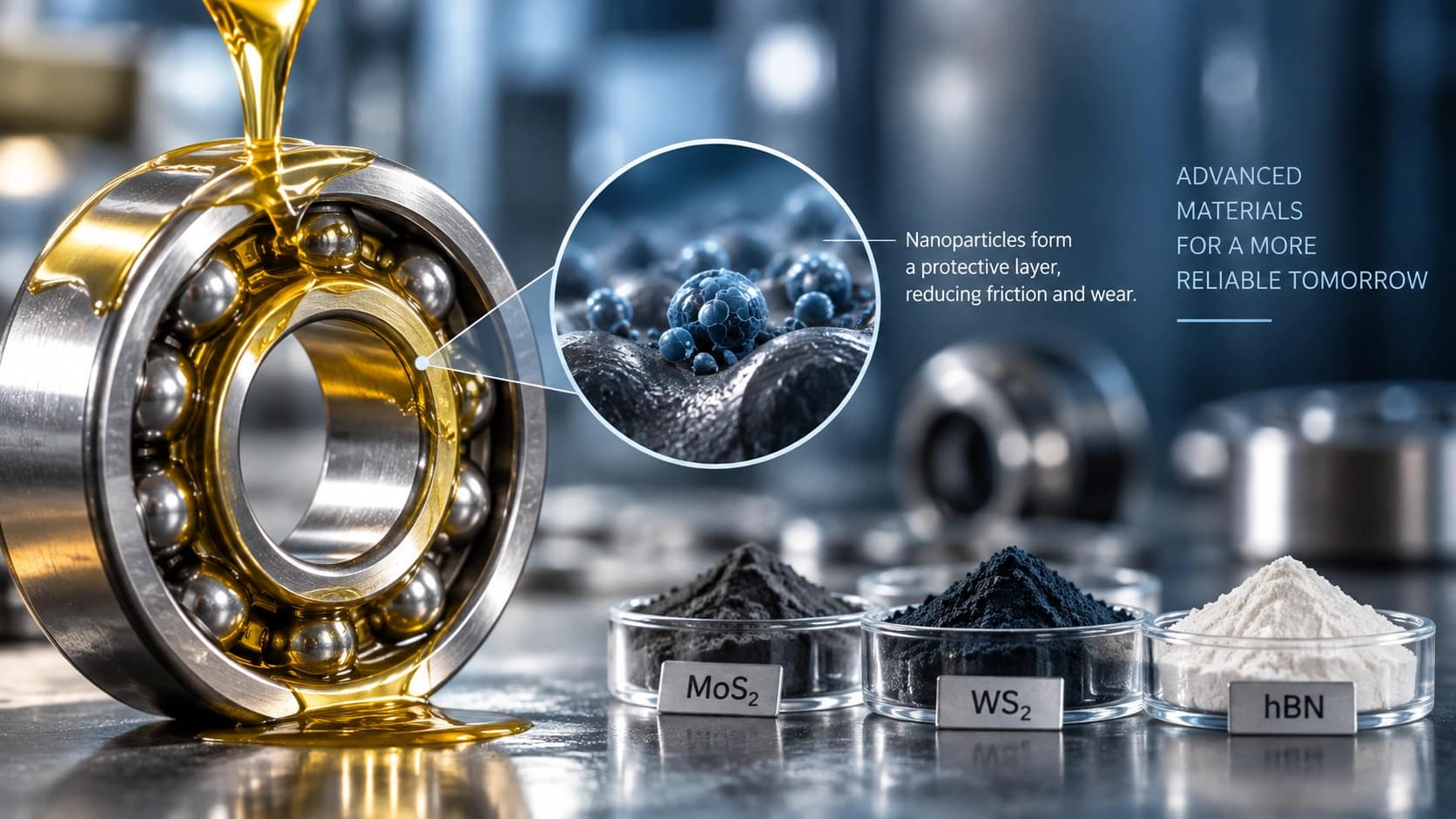
Industrial machinery is being pushed harder than ever. Higher operating temperatures, heavier loads, faster speeds and tighter performance requirements are creating lubrication challenges that conventional solutions cannot always address on their own.
This is one reason nano lubricants are attracting increasing attention across tribology, manufacturing and industrial engineering.
Nanolubricants use nanoparticles or nanoscale materials within a lubrication system to influence friction, wear, heat transfer or surface protection. Depending on the material and formulation, these particles can interact with surfaces at the microscopic level and contribute to improved lubrication performance.
Materials such as Molybdenum Disulfide (MoS₂), Tungsten Disulfide (WS₂) and Hexagonal Boron Nitride (hBN) are particularly relevant because of their established solid-lubrication properties.
But nano lubrication is not simply a matter of adding very small particles to an oil or grease. The material, particle size, concentration, dispersion, compatibility and operating conditions all matter.
So, how does nano lubrication work, and where can it make a practical difference?
What Are Nano Lubricants?
Nano lubricants are lubrication systems containing nanoparticles or nanoscale materials that are used to modify or improve specific lubrication properties.
These materials may be dispersed into oils, greases or other fluids, or they may be incorporated into coatings and dry-lubrication systems.
The purpose can vary depending on the application. A nano additive may be selected to help reduce friction, improve wear resistance, provide surface protection or influence thermal behaviour.
The important point is that “nano” describes the scale of the material, not a guarantee of performance.
A nanoparticle that works well in one lubricant formulation may not perform in the same way in another. Poor dispersion, particle agglomeration or incompatibility with the base lubricant can reduce the expected benefits.
For this reason, nano lubrication needs to be approached as an application-specific engineering solution, rather than simply as the next generation of conventional lubricants.
How Do Nano Lubricants Reduce Friction and Wear?
When two surfaces move against each other, microscopic irregularities on those surfaces can come into contact. Under sufficient load, these contact points can generate friction, heat and wear.
Certain nanoparticles can interact with these surfaces and change what happens at the contact interface.
Depending on the material, nanoparticles may form or contribute to a protective tribofilm, reduce direct surface-to-surface contact, fill microscopic surface irregularities or create a low-shear interface between moving surfaces.
Layered solid lubricants are particularly interesting in this context.
MoS₂, WS₂ and hBN have layered structures in which the layers can slide relative to one another. This characteristic contributes to their usefulness in applications where low-friction behaviour is required.
Research into MoS₂, hBN and other two-dimensional nanoparticles has demonstrated their potential as lubricant additives, although performance depends strongly on concentration, dispersion, base lubricant and test conditions.
This is also why manufacturers should be cautious about assuming that simply increasing nanoparticle concentration will automatically improve lubrication. In some formulations, excessive concentration can lead to agglomeration or other undesirable changes in lubricant behaviour.
Why Are Nanoparticles Used in Industrial Lubricants?
Nanoparticles offer an interesting combination of size, surface area and material properties.
For lubrication applications, the attraction is their ability to interact with surfaces and potentially influence friction and wear at the tribological interface.
Depending on the material, nano lubricant additives may be investigated for:
- Friction reduction
- Wear protection
- High-temperature lubrication
- Extreme-pressure applications
- Surface protection
- Thermal management
- Improved lubricant performance
- Extended component life
However, there is no universal nano additive that works best for every application.
A manufacturer dealing with high-temperature metal processing may have very different requirements from one lubricating a precision bearing or an automotive component.
The right question is therefore not simply, “Which nano lubricant is best?”
It is:
“Which material and formulation are appropriate for this operating environment?”
That distinction is important when evaluating industrial nano lubricants.
What Are the Benefits of Nano Lubricants?
The potential benefits of nano lubricants depend on the material and the system in which it is used. Several areas, however, continue to attract significant industrial and research interest.
Friction Reduction
Reducing friction at contacting surfaces can help improve the efficiency and performance of mechanical systems.
MoS₂, WS₂ and hBN are all recognised as solid-lubrication materials and can be considered where low-friction behaviour is required.
Wear Protection
A suitable nano additive can help reduce direct surface interaction and support the formation of protective films.
This can be relevant to bearings, gears, tooling and other components exposed to repeated contact and sliding.
High-Temperature Lubrication
High temperatures can limit the effectiveness of many conventional lubrication systems.
Some solid lubricants are capable of operating in environments where conventional oils may not be suitable. hBN, for example, is known for its thermal stability and dry-lubrication properties, making it relevant to high-temperature applications.
Heavy-Load and Extreme-Pressure Conditions
MoS₂ and WS₂ are widely studied for applications involving high loads and demanding contact conditions.
WS₂, in particular, is being investigated for applications ranging from machining to advanced lubrication systems. Recent research has also examined WS₂ nanoparticles in minimum-quantity lubrication systems for difficult-to-machine materials.
Component Protection
Where friction and wear are effectively managed, there may be potential to improve component durability and reduce maintenance requirements.
The actual result, however, depends on correct material selection and validation under the customer’s operating conditions.
MoS₂, WS₂ and hBN in Nano Lubrication
Three materials frequently associated with advanced and nano lubrication are Molybdenum Disulfide (MoS₂), Tungsten Disulfide (WS₂) and Hexagonal Boron Nitride (hBN).
Molybdenum Disulfide (MoS₂)
MoS₂ is a layered solid lubricant known for its low-friction characteristics and ability to perform under demanding load conditions.
Its layered structure allows sliding between adjacent layers, making MoS₂ relevant to dry lubrication, coatings and lubricant formulations.
For manufacturers evaluating MoS₂ nano lubricants, particle size is only one consideration. Purity, morphology, dispersion and compatibility with the base lubricant also need to be evaluated.
Tungsten Disulfide (WS₂)
WS₂ is another layered solid lubricant that has attracted attention for high-performance and extreme-condition applications.
Its low-friction characteristics and thermal behaviour make it relevant to areas such as advanced coatings, machining and demanding lubrication systems.
Research has also examined WS₂ nanoparticles in nano-lubrication systems for machining applications, including their effect on friction, heat transfer and tool performance.
Hexagonal Boron Nitride (hBN)
Hexagonal Boron Nitride has a layered structure and is often described as “white graphite.”
It combines low-friction behaviour with high thermal stability and electrical insulation, which makes it particularly interesting for applications where both lubrication and thermal performance matter.
hBN is therefore relevant to high-temperature lubrication, coatings, metal processing and other demanding industrial applications.
Jade Chemicals supplies hBN materials for applications including high-temperature lubrication and industrial coatings.
Where Are Nano Lubricants Used?
Nano lubricants and nanoscale solid-lubrication materials are being explored across industries where conventional lubrication faces demanding conditions.
Potential applications include:
- Bearings and rotating equipment
- Gears and mechanical systems
- Metal forming and forging
- Aluminium extrusion
- Steel processing
- Automotive components
- Aerospace components
- Heavy industrial machinery
- Precision engineering
- Machining
- High-temperature tooling
- Industrial coatings
The application determines the appropriate form of lubrication.
For example, a nanoparticle dispersed in an oil may be relevant to one system, while a dry solid lubricant or hBN coating may be more suitable for a high-temperature metal-processing application.
This is why manufacturers should evaluate the entire lubrication system, rather than focusing only on the nanoparticle itself.
Nano Lubricants vs Conventional Lubricants
Nano lubricants are not automatically replacements for conventional oils and greases.
Conventional lubricants remain extremely effective across a wide range of industrial applications. Nano additives become interesting when a particular application presents a performance challenge involving friction, wear, temperature, load or thermal behaviour.
In other words, the question is not:
“Are nano lubricants better than conventional lubricants?”
The more useful question is:
“Which lubrication technology is best suited to this application?”
In some cases, a conventional lubricant will be entirely appropriate. In others, a specialty grease, solid lubricant, coating or nano-enhanced formulation may provide a better route to the required performance.
That application-first approach is particularly important for industrial procurement teams.

What Should Manufacturers Consider When Selecting Nano Lubricants?
Choosing a nano lubricant requires more than looking at particle size.
Manufacturers should evaluate several factors before selecting a material.
Operating temperature: What temperatures will the lubrication system experience during normal and peak operation?
Load and pressure: Is the material expected to operate under heavy or extreme-pressure conditions?
Particle size and morphology: Does the material have characteristics appropriate for the intended application?
Dispersion stability: Will the particles remain adequately dispersed, or are they likely to agglomerate?
Base lubricant compatibility: Can the nanoparticle be incorporated into the oil or grease without negatively affecting the formulation?
Surface compatibility: How will the material interact with the component or coating surface?
Concentration: What concentration is appropriate for the intended application? More additive does not necessarily mean better performance.
Application method: Will the material be used in oil, grease, a coating, dry form or another system?
Technical documentation: Can the supplier provide specifications, particle information and relevant application guidance?
Dispersion deserves particular attention. Research on nanoparticle-based lubricants has shown that stability and dispersion can significantly affect tribological performance.
For manufacturers, this means that selecting a good nanoparticle is only part of the equation. The way that material behaves within the finished lubrication system matters just as much.
The Future of Nano Lubrication in Industry
Industrial machinery is becoming more demanding, and lubrication technology is evolving with it.
Manufacturers are looking for ways to control friction and wear while operating equipment at higher speeds, temperatures and loads.
That creates opportunities for nano lubrication technology and advanced solid lubricants.
Research is increasingly examining individual nanoparticles as well as combinations of materials. Studies have explored MoS₂, hBN, graphene and other two-dimensional materials, including combinations designed to take advantage of different properties.
At the same time, challenges such as dispersion stability, formulation compatibility, cost and long-term performance still need to be addressed.
Nano lubricants are therefore unlikely to replace conventional lubrication across the board.
Instead, they are likely to become another important tool for applications where conventional approaches have limitations.
The direction is clear: more application-specific lubrication, better control of friction and wear, and increasingly sophisticated materials designed around real operating conditions.
Choosing the Right Nano Lubrication Material
For manufacturers exploring nano lubricants, the starting point should not be the smallest particle or the lowest price.
It should be the application.
Temperature, load, speed, surface material, lubricant type, dispersion requirements and expected service life all influence material selection.
Jade Chemicals supplies specialty industrial lubricants and advanced lubrication materials, including MoS₂, WS₂ and hBN, alongside PTFE Micronized Powder, High-Temperature EP Grease, Anti-Friction Sprays and hBN Coatings.
These materials serve different lubrication requirements, which is why product selection needs to be based on the intended application rather than a one-size-fits-all approach.
For industrial buyers, the right supplier should be able to discuss more than product availability. Technical specifications, particle characteristics, application requirements, consistency and documentation all matter when evaluating an advanced lubrication material.
Nano lubrication is ultimately not about making lubrication more complicated.
It is about solving specific friction, wear and performance challenges with materials engineered for the job.
As industrial applications become more demanding, that distinction will become increasingly important.
The future of industrial lubrication will not simply be about smaller particles. It will be about better material selection, better formulation and better understanding of the surfaces being lubricated.
To explore Jade Chemicals’ range of specialty industrial lubricants and advanced lubrication materials, visit www.jadechemicals.in.
Frequently asked questions
Hexagonal Boron Nitride is used in high-temperature lubrication, mould release, surface protection, thermal management and electrical insulation. Industrial applications include metal processing, forging, aluminium extrusion, tooling and high-temperature manufacturing. It is also being studied for electronics and two-dimensional material technologies.
Hexagonal Boron Nitride has a layered structure that gives it useful dry-lubrication characteristics. It can be used in applications where conventional oil- or grease-based lubricants may not be suitable because of high temperatures. hBN powder and hBN coatings are therefore used for selected high-temperature industrial applications.
No. Hexagonal Boron Nitride is an electrical insulator. This is one of its important differences from graphite and is a key reason it is being investigated for thermal-management and electronic applications.
Hexagonal Boron Nitride is more accurately described as a wide-bandgap electrical insulator, rather than a conventional semiconductor. Its importance in semiconductor and advanced electronics research comes from its use as a dielectric, insulating layer, substrate and encapsulation material alongside other semiconductor and two-dimensional materials.
Hexagonal Boron Nitride is used across metal processing, aluminium extrusion, forging, aerospace, electronics, thermal management and advanced materials. Its established industrial uses include dry lubrication, release and surface protection in high-temperature applications.
Jade Chemicals supplies Hexagonal Boron Nitride powder in India in different particle sizes and grades for industrial applications. The company also supplies hBN coatings and aerosol formulations for high-temperature lubrication, release and surface-protection applications.