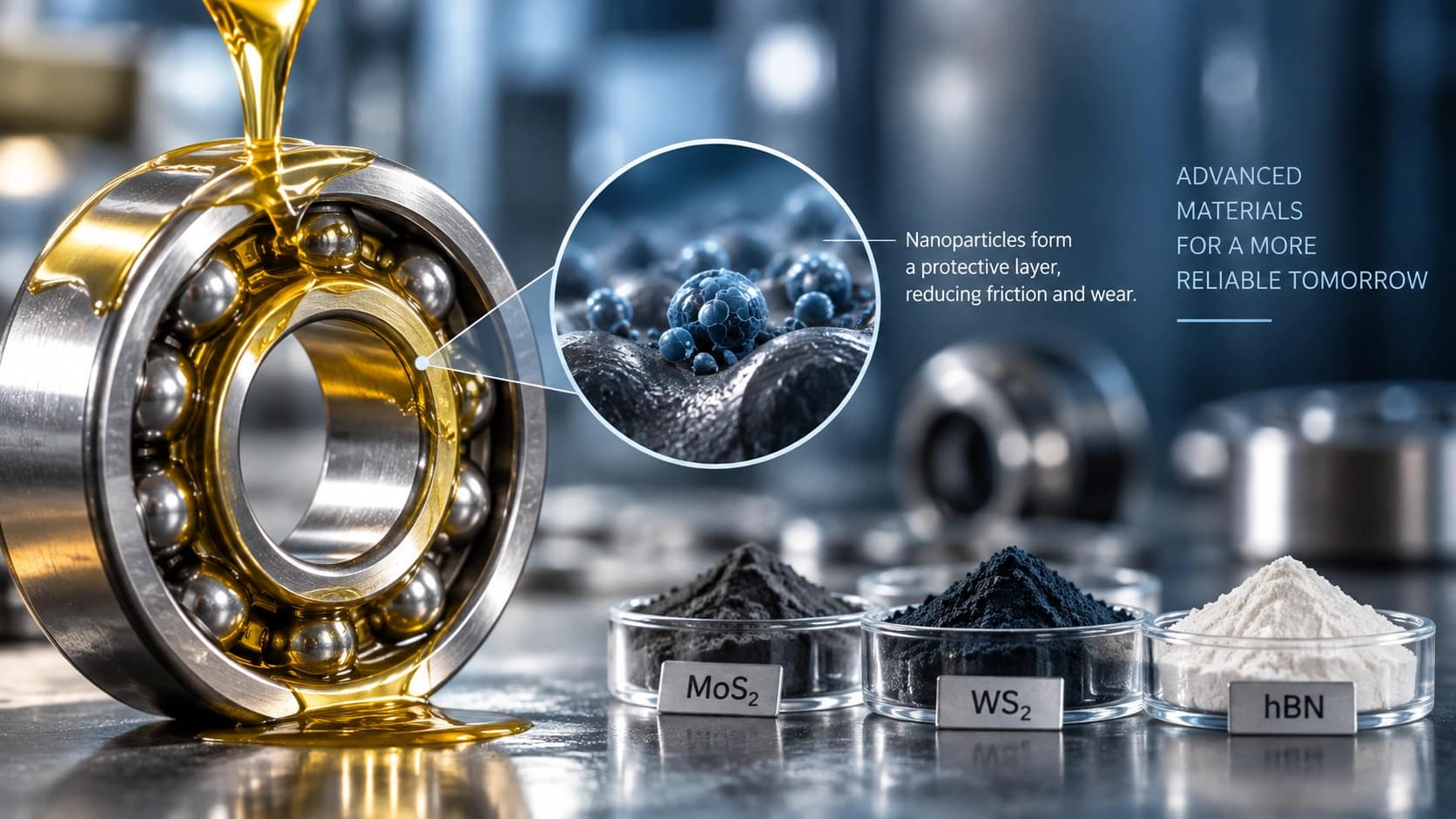
Some industrial materials are known for doing one job particularly well.
Hexagonal Boron Nitride (hBN) is interesting because it can solve very different engineering problems. For years, it has had a practical role in high-temperature manufacturing, where it is used for dry lubrication, mould release and surface protection. Today, the material is also attracting attention in thermal management, electronics and research involving two-dimensional materials.
At first glance, those applications may appear unrelated. They aren’t.
The reason Hexagonal Boron Nitride continues to find new uses is the unusual combination of properties it brings together: high-temperature stability, low friction, electrical insulation, thermal conductivity and chemical resistance. The importance of each property depends on the application.
In a metal-processing operation, the priority may be preventing a hot material from sticking to a tool. In electronics, the requirement may be to move heat while keeping the material electrically insulating.
Same material. Very different engineering problem.
What Makes Hexagonal Boron Nitride Different?
Hexagonal Boron Nitride has a layered structure that is often compared with graphite. The comparison is useful because, like graphite, its layers can slide against each other, giving it useful dry-lubrication characteristics. But there is a fundamental difference.
Graphite conducts electricity. Hexagonal Boron Nitride is an electrical insulator.
That distinction is one of the reasons hBN has applications beyond conventional lubrication. Its structure and properties allow it to work as a dry lubricant in demanding environments while also making it useful where electrical insulation is required.
Jade Chemicals supplies Hexagonal Boron Nitride powder in different particle sizes and grades for applications including high-temperature lubrication, thermal management, mould release, coatings and electrical insulation. The material can also be formulated into coatings and aerosol products where a controlled surface layer is required.
High-Temperature Manufacturing: Where hBN Has a Proven Role
Some of the most established applications of Hexagonal Boron Nitride remain in industries where temperatures make conventional lubrication difficult. In metal processing, forging and related high-temperature operations, tooling and working surfaces can be exposed to substantial heat, friction and repeated thermal cycles. In these conditions, a conventional oil-based lubricant may simply not be the right solution.
Hexagonal Boron Nitride can be used as a dry lubricant, release material or protective coating in suitable applications. Its role may be to reduce friction, minimise adhesion or create a barrier between the tool and the material being processed. Jade Chemicals supplies hBN products for applications involving metal processing, forging, sintering, dies, moulds and high-temperature tooling.
The objective is not necessarily to make the machinery run faster. Often, it is much more practical: Keep the material from sticking. Protect the tooling. Maintain a clean working surface.
That can have a direct impact on process consistency and tool life.
Aluminium Processing: Managing Heat, Friction and Adhesion
Aluminium processing presents another demanding environment for tooling and dies. During extrusion, casting and forming, the interaction between hot metal and tooling can affect surface finish, production efficiency and tool performance. This is one area where Hexagonal Boron Nitride coatings can be useful. An hBN coating can provide a dry lubricating and release layer between the working surface and the material being processed. Jade Chemicals specifically positions its hBN coatings for applications including aluminium extrusion, die casting, metal forming and forging. The value of the coating lies in controlling the surface interaction—not simply in its ability to withstand high temperatures. That distinction is important when evaluating specialty materials. A material earns its place when it solves a specific process problem.
When Heat Management Becomes the Challenge
The story becomes even more interesting when we move from metal processing to electronics. Electronic devices continue to become more compact and powerful. As power density increases, so does the need to move heat away from sensitive components. But there is a catch. The material used to move heat should not necessarily conduct electricity. This is where Hexagonal Boron Nitride has attracted considerable interest.
It combines thermal conductivity with electrical insulation, making it relevant to research and applications involving thermal interface materials, electronic packaging, thermally conductive composites and related systems.
Jade Chemicals lists hBN for use in thermal pastes, greases, ceramics, composites and coatings where thermal management and electrical insulation are required. The actual thermal performance of an hBN-based formulation depends on factors such as particle characteristics, loading, orientation and the surrounding material. So hBN should not be treated as a universal answer to every thermal-management problem. Its attraction is more specific:
It can help move heat without creating an electrically conductive path.
For certain electronic applications, that is a valuable combination.
What Is the Connection Between hBN and Semiconductor Technology?
This is an area where terminology matters. Hexagonal Boron Nitride is not a conventional semiconductor such as silicon. It is a wide-bandgap electrical insulator. Its importance to semiconductor and advanced electronics research comes from the role it can play around other electronic materials. Researchers have investigated hBN as a dielectric, insulating layer, substrate and encapsulation material. Its atomically smooth surface, chemical stability and layered structure make it particularly useful in systems built from two-dimensional materials.
One important example is its use alongside graphene and semiconducting transition-metal dichalcogenides.
In these systems, hBN can provide a cleaner and more controlled interface than many conventional substrates. Research has shown that hBN’s atomically flat surface and low density of unwanted surface effects can be valuable when working with graphene and other two-dimensional materials.
More recent research continues to investigate hBN as a dielectric and interface material for advanced two-dimensional and quantum devices. So the semiconductor connection should be described carefully. hBN is not replacing silicon as a semiconductor.
Instead, it can act as an enabling material around semiconductor and two-dimensional material systems, providing insulation, encapsulation and controlled interfaces where those characteristics are needed. That is a more accurate—and more useful—way of understanding its role.
One Material. Very Different Industrial Needs.
What makes Hexagonal Boron Nitride particularly interesting is the range of problems it can address. A metal-processing operation may need a material that can withstand heat while reducing adhesion. An aluminium extrusion process may need a coating that provides lubrication and release at the die surface. A forging application may require dry lubrication under severe thermal conditions. An electronics application may need a thermally useful material that remains electrically insulating. A researcher working with two-dimensional materials may be interested in hBN as an insulating layer or controlled interface. These are very different requirements.
What connects them is the underlying structure and properties of Hexagonal Boron Nitride.
This is often where specialty materials create their value. They do not have to replace conventional materials everywhere. Their importance comes from the situations in which their particular combination of properties offers something that conventional materials cannot provide as effectively.
Why Hexagonal Boron Nitride Is Worth Watching
The evolution of hBN is a good example of how an established industrial material can become relevant to new areas of technology. Its traditional applications in high-temperature lubrication, release and surface protection remain important. At the same time, its thermal and electrical properties are supporting continued research into electronics, thermal management and two-dimensional material systems. For manufacturers, this matters because industrial processes are becoming more demanding. Higher operating temperatures. More precise tooling. Greater automation. More sophisticated electronic systems. All of these developments create situations where material selection becomes increasingly important.
Hexagonal Boron Nitride sits at an interesting point within that landscape.
It can be a practical industrial material in one application and an enabling material in advanced research in another.
That is what makes it more than simply another industrial powder or coating. Its value lies in what its properties allow engineers to do.
Hexagonal Boron Nitride from Jade Chemicals
At Jade Chemicals, Hexagonal Boron Nitride is part of our wider range of specialty industrial materials and lubrication solutions.
We supply Hexagonal Boron Nitride powder, hBN coatings and hBN aerosol spray for applications involving high-temperature lubrication, release, surface protection and specialised industrial processes. Our hBN powder is available in different particle sizes and grades, while our coating products are designed for applications including aluminium extrusion, die casting, forging, metal forming and other high-temperature operations.
Jade Chemicals also supplies a broader portfolio of specialty materials including Tungsten Disulfide (WS₂), Molybdenum Disulfide (MoS₂), PTFE-based products, High-Temperature EP Grease, anti-friction sprays and specialty coatings.
Our approach is application-led. The right material depends on the operating environment, the process and the problem that needs to be solved. If you are evaluating Hexagonal Boron Nitride powder, hBN coating or hBN aerosol spray for an industrial application, speak to Jade Chemicals about your requirements. Explore our Hexagonal Boron Nitride range or contact our team to discuss your application.
Looking for Hexagonal Boron Nitride for a specific industrial application? Contact Jade Chemicals to discuss your requirements.
Frequently asked questions
Hexagonal Boron Nitride is used in high-temperature lubrication, mould release, surface protection, thermal management and electrical insulation. Industrial applications include metal processing, forging, aluminium extrusion, tooling and high-temperature manufacturing. It is also being studied for electronics and two-dimensional material technologies.
Hexagonal Boron Nitride has a layered structure that gives it useful dry-lubrication characteristics. It can be used in applications where conventional oil- or grease-based lubricants may not be suitable because of high temperatures. hBN powder and hBN coatings are therefore used for selected high-temperature industrial applications.
No. Hexagonal Boron Nitride is an electrical insulator. This is one of its important differences from graphite and is a key reason it is being investigated for thermal-management and electronic applications.
Hexagonal Boron Nitride is more accurately described as a wide-bandgap electrical insulator, rather than a conventional semiconductor. Its importance in semiconductor and advanced electronics research comes from its use as a dielectric, insulating layer, substrate and encapsulation material alongside other semiconductor and two-dimensional materials.
Hexagonal Boron Nitride is used across metal processing, aluminium extrusion, forging, aerospace, electronics, thermal management and advanced materials. Its established industrial uses include dry lubrication, release and surface protection in high-temperature applications.
Jade Chemicals supplies Hexagonal Boron Nitride powder in India in different particle sizes and grades for industrial applications. The company also supplies hBN coatings and aerosol formulations for high-temperature lubrication, release and surface-protection applications.